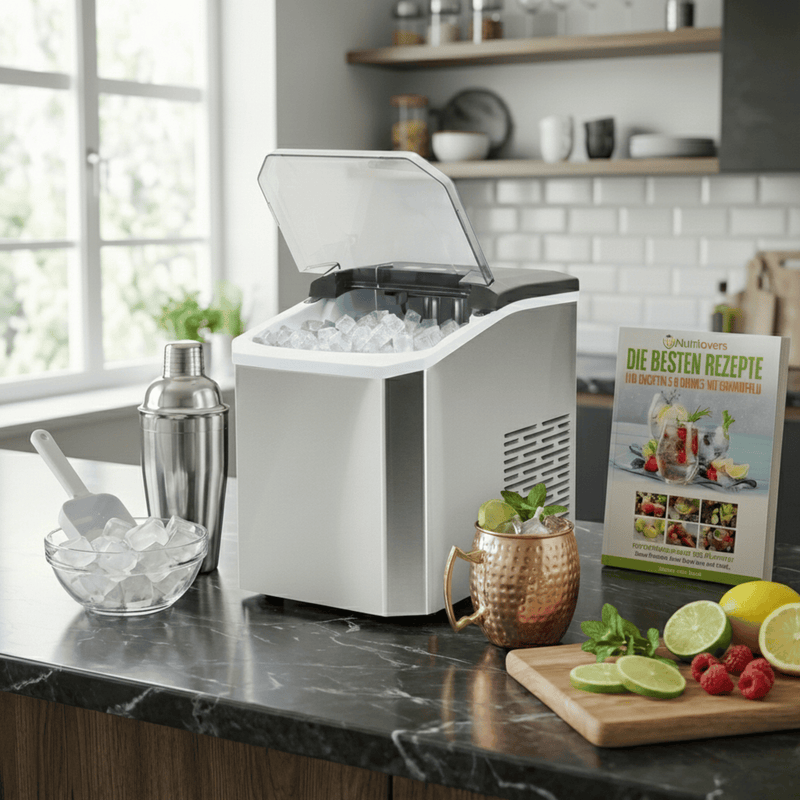







Why an Ice Cube Maker Saves the Summer
Are you looking to buy an ice cube maker but don't know what to look for? We've all been there. You're looking forward to a cool drink, open the freezer, and the little bit of ice left is barely enough for one glass. Never mind the next round.
That's exactly where your own ice cube maker comes in. It makes fresh ice cubes right in your kitchen—without having to wait for ice cube trays in the freezer.
Whether for cocktails, iced coffee, soft drinks, smoothies, or the next barbecue, an ice cube maker is especially convenient if you regularly serve chilled drinks.
But which machine is right for you? How much ice should it produce? Which ice shape makes sense, and which features do you really need?
Here you'll find out what to look for when buying and which criteria really matter in everyday use.
The Most Important Buying Criteria at a Glance
1. The Right Ice Shape: Which Ice Cubes Do You Need?
Not all ice cubes are the same. Depending on the drink and occasion, a different ice shape may make more sense.
| Ice Type | Benefits | Ideal for |
|---|---|---|
| Small ice cubes | Cool drinks quickly | Soft drinks, water, and juices |
| Large ice cubes | Melt slower under comparable conditions | Whiskey and cocktails |
| Crushed ice | Easy to distribute and cools quickly | Mojitos, punch, and desserts |
Not every ice cube maker can make all ice shapes. For example, many compact devices produce smaller or larger ice pieces in a typical hollow cone shape.
Tip: Before buying, think about what you mainly want to use the ice for. If you prepare different drinks, a machine with multiple ice sizes is particularly convenient.
2. Performance and Speed: How Quickly Does the Machine Make Ice?
Production speed is an important buying criterion. After all, you don't want to wait half an hour before you can enjoy your first drink.
For compact ice cube makers, a production cycle often takes about 6 to 10 minutes. The actual time depends on several factors, including the machine, room temperature, and water temperature.
Also pay attention to the stated daily production. It shows you how much ice the machine can make within 24 hours under the respective conditions.
| Usage | Guide for daily production |
|---|---|
| Occasional, a few drinks | 5–8 kg |
| Family and smaller parties | 8–15 kg |
| Frequent use and larger parties | 15 kg and more |
These values are estimates and not a guarantee of the actually available amount of ice. It is also important how quickly you can remove and reuse the finished ice.
My advice: It's better to plan a little generously. Especially at family parties or barbecues, more ice is needed than you might initially think.
3. Water Tank and Water Connection: How Flexible Should the Machine Be?
Ice cube makers offer different options for water supply.
External water tank
-
Easy to fill with water
-
No permanent water connection required
-
Flexible placement
-
Must be refilled regularly
Direct water connection
-
Automatic water supply
-
No manual refilling required
-
Practical for frequent use
-
Requires a suitable water connection
For normal use at home, an integrated water tank is usually more than sufficient.
Pay attention to the tank volume. A larger tank means you have to refill it less often. It is also important that the tank is easy to clean.
4. Energy Consumption: How Much Does Ice Production Cost?
An ice cube maker requires electricity to cool the water and make ice. The amount of consumption depends on several factors, including power, operating time, and ambient temperature.
Therefore, when comparing, don't just look at the wattage. It describes the electrical power of the device, but not the actual power consumption over an entire day.
If you use your machine frequently, it is worth paying attention to the following points:
-
Power consumption rating in watts
-
Efficient cooling
-
Good heat dissipation
-
Device size suitable for your needs
-
Option to turn off the device when not in use
A device with a higher wattage is not automatically worse or more expensive to operate. What matters is how efficiently it produces the desired amount of ice.
5. Cleaning and Hygiene: What You Should Look For
Since an ice cube maker works with water and produces ice for drinks, regular cleaning is particularly important.
The following features are practical:
-
Removable or easily accessible water tank
-
Smooth interior surfaces
-
Easily accessible water areas
-
Easy emptying
-
Self-cleaning function, if available
A self-cleaning function can make maintenance easier. However, it does not replace regular manual cleaning according to the manufacturer's instructions.
Use only suitable cleaning agents. Vinegar or citric acid are not suitable for every device and can damage certain materials or components. Therefore, follow the manufacturer's care instructions.
Tip: Empty the water tank if you do not use the machine for a long time. Clean and dry the accessible areas regularly.
Extras That Are Really Worth It
In addition to the basic features, there are some extras that can make everyday use easier.
| Feature | Your Benefit |
|---|---|
| Self-cleaning function | Supports regular cleaning |
| LED display | Displays operating status and prompts |
| Water level indicator | You can see when the water needs to be refilled |
| Ice full indicator | Informs you when the ice container is full |
| Two ice sizes | More flexibility with drinks |
| Stainless steel housing | Robust and high-quality appearance |
A UV function for additional water treatment may be available on certain devices. However, it is not a must and replaces neither cleaning nor hygienic handling.
My tip: Don't let yourself be dazzled by as many additional features as possible. A good ice cube maker should above all produce ice reliably, be easy to use, and uncomplicated to clean.
Price Categories: What Do You Get for Your Money?
Ice cube maker prices vary depending on equipment, performance, and design.
| Category | Price (Guide) | Typical Features |
|---|---|---|
| Entry-level | €50–100 | Simple operation, smaller capacity |
| Mid-range | €100–300 | Often multiple ice sizes, higher daily output |
| Premium | from €300 | Depending on the model, larger capacity and additional features |
The prices are rough estimates and may vary depending on the manufacturer and offer.
For the average household, an entry-level or mid-range model is often sufficient. If you regularly need larger quantities of ice, you should pay closer attention to daily output, the water tank, and cooling.
Important: A high price is not automatically a sign of quality. It is better to compare the technical specifications and features you actually need.
Which Ice Cube Maker Is Right for You?
Not everyone needs the same equipment. Therefore, think about how often you want to use the machine.
For Beginners and Small Households
If you mainly cool drinks occasionally, a compact model with a water tank and simple operation is sufficient.
Look for:
-
Compact dimensions
-
Simple operation
-
Sufficient daily production
-
Easily accessible water tank
For Families and Small Parties
If you regularly receive guests or serve multiple people with chilled drinks, the machine should be able to do a little more.
Look for:
-
Higher daily production
-
Sufficient tank volume
-
Short production cycles
-
As simple cleaning as possible
For Parties and Frequent Use
For larger parties, a high daily output is particularly important. A fast production cycle and a sufficiently large ice container can also make a difference.
Look for:
-
High daily ice production
-
Fast ice preparation
-
Sufficient water and ice containers
-
Robust construction
A direct water connection can be practical for very frequent use. However, it is not necessary for many households.
Maintenance and Spare Parts – Think Long-Term
To ensure your ice cube maker continues to work reliably for a long time, you should maintain it regularly.
These points will help you:
-
Clean regularly: Remove water residue and deposits according to the manufacturer's instructions.
-
Empty the water tank: If you do not use the machine for a long time, you should remove the water.
-
Avoid limescale deposits: Depending on the water hardness, regular descaling may be necessary.
-
Check for spare parts: Find out if important parts such as the tank, lid, or water pump are available.
-
Pay attention to the warranty: Compare the manufacturer's warranty conditions and customer service.
You should also keep the user manual. There you will find important information on cleaning and caring for your device.
Space Requirements and Ventilation: Where Do You Place the Machine?
One point that is often forgotten when buying is the space required.
An ice cube maker requires not only floor space but also sufficient space for air circulation. During operation, heat is generated, which must be dissipated through the ventilation openings.
Therefore, keep in mind:
-
Measure the available floor space before buying.
-
Check the height and depth of the device.
-
Pay attention to the position of the ventilation openings.
-
Maintain the distances from walls and other objects recommended by the manufacturer.
-
Place the device on a stable, level surface.
This allows the machine to operate properly and prevents the cooling from being unnecessarily affected.
Other Uses: More Than Just Ice Cubes for Drinks
An ice cube maker is not only practical for water, cola, or cocktails. With enough ice, you can also do many other things in everyday life.
Here are a few ideas:
-
Cocktails and mocktails: Ice cubes for summer drinks with and without alcohol.
-
Iced coffee and iced tea: For a quick cool-down on hot days.
-
Smoothies: Ice cubes for a pleasantly cool consistency.
-
Punch and desserts: For summer buffets and garden parties.
-
Fruit platters: Ice can help keep fruit cool while serving.
-
Herb ice cubes: Freeze water with herbs, berries, or edible flowers in ice cube trays.
Important: If you want to keep food such as fish or meat cool, you should use suitable cooling containers. Ice cubes from a drink machine are not automatically suitable for the safe storage of perishable food.
Conclusion: How to Find the Right Ice Cube Maker
If you want to buy an ice cube maker, you should not just look at the price. What matters is that the device suits your everyday life and your actual needs.
Pay particular attention to these five points:
-
Daily output: How much ice do you really need?
-
Production time: How quickly should the machine make ice?
-
Water tank: How often do you want to refill the water?
-
Cleaning: Is the machine easy to maintain?
-
Size and equipment: Does the device fit in your kitchen and offer the features you need?
Whether for an everyday iced coffee, a family celebration, or your next garden party, the right ice maker lets you make fresh ice at the touch of a button, so you can enjoy perfectly chilled drinks anytime.