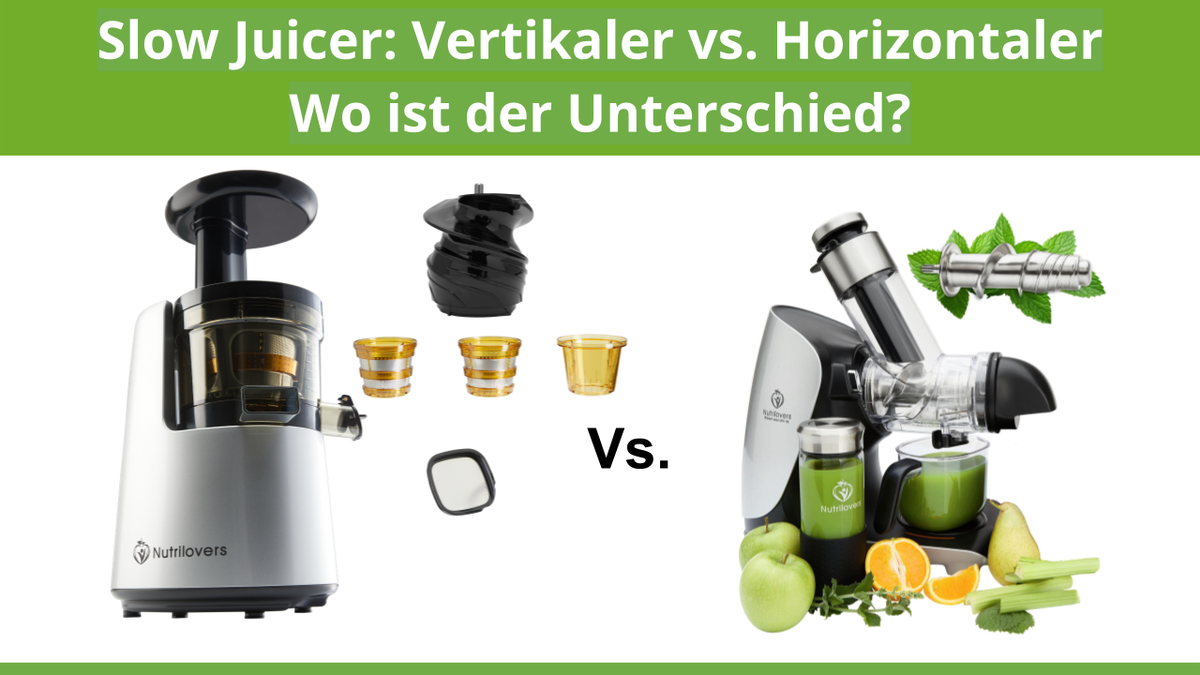







Vertical or horizontal slow juicer – which one is right for you? Both designs work with a slowly rotating auger and are suitable for preparing freshly squeezed fruit and vegetable juices. However, there are some important differences.
If you want to buy a slow juicer, you shouldn't just look at price and performance. The deciding factor is primarily which ingredients you want to juice most often, how much space you have in your kitchen, and which features are important to you.
In this comparison, we will show you the most important differences between vertical and horizontal slow juicers.
Vertical or horizontal slow juicer – which one is better?
There is no one-size-fits-all answer. Both designs have their own advantages and are suitable for different requirements.
The most important question is therefore:
What do you mainly want to juice?
If you mainly want to process fruit and classic vegetables for mixed juices, a vertical slow juicer can be particularly practical. If, on the other hand, you often want to juice fibrous leafy greens, herbs, or wheatgrass, a horizontal slow juicer may be the better choice.
Factors such as space requirements, feed chute, cleaning, and additional functions also play a role in the decision.
The most important difference: the design of the auger
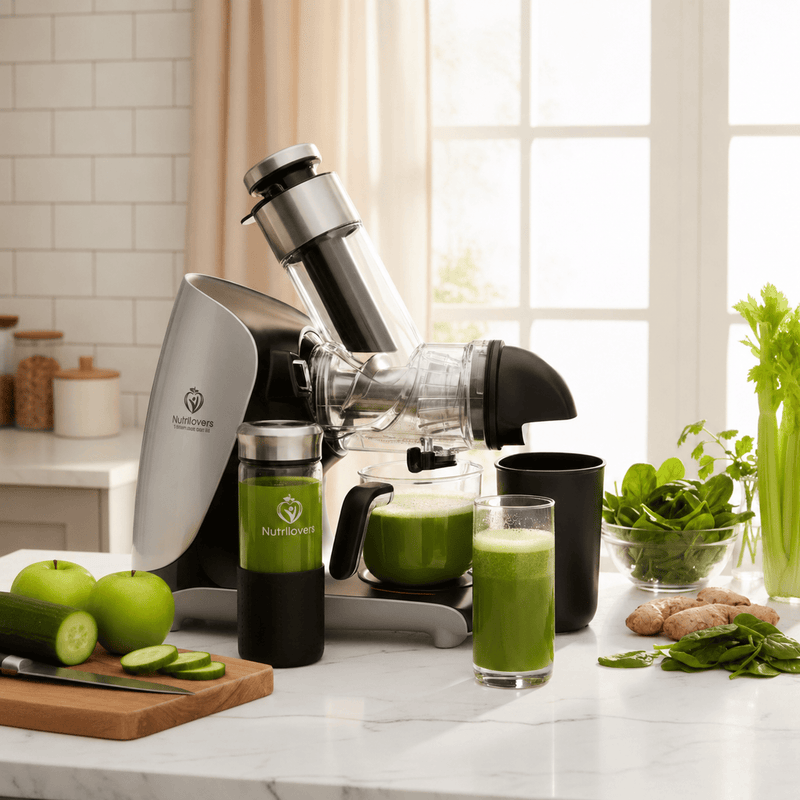
Horizontal slow juicer: Especially interesting for fibrous produce
A horizontal slow juicer can really show its strengths with fibrous ingredients.
These include, for example:
- Celery
- Wheatgrass
- Herbs
- Leafy greens
- Kale
- Chard
- Lettuce
- Other high-fiber ingredients
How does a horizontal slow juicer work?
The produce is placed into the pressing chamber via the feed chute and processed by the horizontally arranged auger.
Depending on the model, it may be necessary to use a plunger. The juice is then separated from the pulp and collected in a container.
Due to the horizontal design, these devices are usually somewhat wider and require more counter space accordingly.
Vertical slow juicer: Convenient for fruit and vegetable juices
Typical combinations include, for example:
- Apple & carrot
- Orange & carrot
- Apple & celery
- Cucumber & apple
- Carrot & ginger
Even with vertical models, however, you should always observe the manufacturer's instructions for the respective produce.
Vertical vs. horizontal slow juicer in direct comparison
|
Feature |
Vertical Slow Juicer |
Horizontal Slow Juicer |
|
Design |
Auger is vertical |
Auger is horizontal |
|
Operation |
Often very convenient |
Sometimes requires more pushing |
|
Fruit & softer vegetables |
Very well suited |
Very well suited |
|
Fibrous vegetables |
Suitable depending on model |
Often particularly well suited |
|
Leafy greens & herbs |
Depending on model |
Especially interesting |
|
Wheatgrass |
Model-dependent |
Often well suited |
|
Space requirement |
Usually more compact |
Usually wider |
|
Cleaning |
Depending on model, somewhat easier |
Depending on model, somewhat more laborious |
|
Other features |
Model-dependent |
Model-dependent |
Important: These differences are general guidelines. Construction, auger, screens, filters, and accessories can differ significantly from model to model.
Cleaning: Which slow juicer is easier?
A slow juicer consists of several individual parts and therefore generally requires a bit more effort to clean than a simple blender container.
However, how quickly cleaning goes depends heavily on the respective model.
For many vertical devices, cleaning can be somewhat easier due to the more compact design. Horizontal models, on the other hand, can take a little more time due to their longer pressing chamber.
Tip for easier cleaning
If your model is suitable for it, you can run water through the device immediately after juicing. For devices with forward and reverse functions, the reverse function can also help to dislodge stuck produce.
Important: For precise cleaning, you should always consult your device's user manual.
Motor power and rotations: What really matters?
With a slow juicer, you shouldn't be impressed solely by high wattage.
The wattage primarily describes the motor power. Alone, however, it does not indicate how well a device juices.
The rotational speed of the auger, the construction of the pressing chamber, the auger itself, and the screen or filter used also influence how the device works.
A low speed is typical for the slow juicing principle. Even so, it is not automatically true that:
The fewer rotations, the better the juice.
The decisive factor is the interplay of various factors and, above all, the quality of the entire design.
How many rotations should a slow juicer have?
Many slow juicers operate at a relatively low speed, often in the range of about 40 to 100 rotations per minute.
For your purchase decision, however, you should not look at the speed in isolation. A good device should suit your desired produce, your usage habits, and your demands regarding operation and cleaning.
If you want to regularly juice fibrous vegetables, the design of the auger and the screen or filter used are particularly interesting, for example.
What should you consider when buying a slow juicer?
Before you decide on a model, you should ask yourself a few questions:
1. What do you mainly want to juice?
Fruit, carrots, and softer vegetables? Or mainly celery, leafy greens, and herbs?
2. How much space do you have in the kitchen?
Vertical models often require less counter space in terms of width. Horizontal models, on the other hand, are usually longer or built wider.
3. How important is simple operation to you?
If you want to prepare juice as easily and regularly as possible, you should look for a convenient feed chute and simple handling.
4. Which screens or filters are included?
Depending on the model, different screens or filters may be included. These can influence the consistency and the possible preparations.
5. What would you like to prepare besides juice?
Depending on the equipment, some slow juicers offer further possibilities, such as preparing sorbet or other recipes.
6. How easy is it to clean the device?
Look for individual parts that are easy to disassemble and see how uncomplicated it is to clean the pressing chamber, screen/filter, and other components.
Conclusion: Vertical or horizontal?
The best slow juicer is the one that fits your habits.
A vertical slow juicer can be particularly practical if you want to easily prepare fruit and vegetable juices as well as mixed juices and value a compact design.
A horizontal slow juicer can be interesting if you often want to process fibrous produce like celery, leafy vegetables, herbs, or wheatgrass.
In the end, you shouldn't just decide based on "vertical" or "horizontal," but rather compare your personal requirements.
In short:
- Fruit & classic mixed juices: Vertical can be particularly practical.
- Leafy greens & fibrous produce: Horizontal can offer advantages.
- Limited counter space: Vertical models are often more compact.
- Simple cleaning: Heavily dependent on the specific model.
- Other preparations: Compare equipment and accessories.
This makes it easier to find a slow juicer that really fits your everyday life.
READ MORE
If you want to know which juicer is best suited for celery juice, we recommend our article:
- ▷ Buying a slow juicer: 10 points you should definitely pay attention to
- Other related articles:
- ▷ What is slow juicing? "Slow juice" - The trend in detail
- ▷ Smoothie vs. juice - What is the difference and what is healthier?
- ▷ Which vegetables are suitable for a slow juicer? The top 12 vegetables for juicing
- ▷ Which fruits and vegetables are not suitable for a slow juicer?